
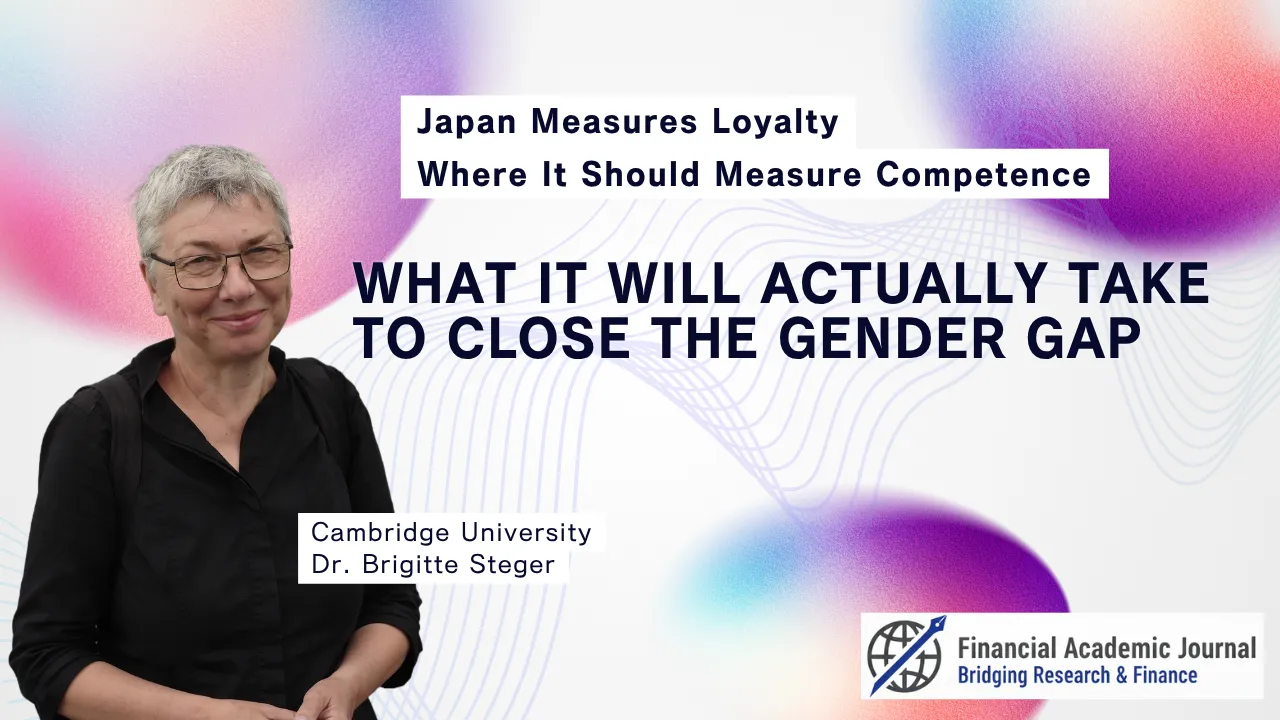
Listed among the SDGs and debated in every corner of the world, gender equality has become impossible for any organization to sidestep. Japan, however, sits near the bottom of the “Global Gender Gap Index,” and the distance separating men from women in its business world has narrowed only marginally over the years. Whatever shape Japanese society takes next, corporations will be expected to confront that disparity in earnest.
With that in mind, we spoke with Dr. Brigitte Steger of the University of Cambridge, whose research centres on gender in Japan, about where the gap actually lies and what might close it.

Interviewee
Brigitte Steger
Professor, University of Cambridge
Dr. Brigitte Steger works in the fields of Japanese Studies and Cultural Anthropology, and holds a professorship at the University of Cambridge, where Japanese society is the subject she teaches. Austrian by nationality, she took both her Mag. Phil. and her Dr. Phil. in Japanese Studies at the University of Vienna, with Sociology and Political Science as her minor subjects.
She additionally chairs the Cambridge University Japan Gender Research Group. Volumes she has edited include Manga Girl Seeks Herbivore Boy (2013), Cool Japanese Men (2017) and Beyond Kawaii (2020).
125th Out of 146: Where Japan’s Score Actually Comes From
Financial Academic Journal (hereafter, FAJ):
Japan’s placement in the annual “Gender Gap Index” is consistently poor. Given how much is said about women advancing into public and professional life, why does the distance between men and women appear to hold steady, even measured against the rest of the world?
Ms. Brigitte Steger:
The World Economic Forum released its “Global Gender Gap Report” in June 2023, and Japan’s position came in at 125th among 146 countries. That represented a fall of nine places from the 116th spot it occupied in 2022 — the poorest result the country has ever posted.
The report, however, is assembled from four principal categories:
- economic participation and opportunity
- educational attainment
- health and survival
- political empowerment
Where Japan is concerned, “health” and “education” show relatively little separation between the sexes. The visible shortfall appears under “economics” and “politics,” and the political figure is dismal in particular — 138th worldwide. So parity may hold across schooling and health outcomes, but claiming that no gap exists in economic and political life is simply not sustainable.
The Wall That Appears in a Woman’s Thirties
FAJ:
Turning to that gap in economics and politics, what does it look like concretely?
Ms. Brigitte Steger:
Japan’s standing under the “politics” heading of the index is widely reported. On the “economic participation” side, a major driver of the shortfall is how seldom women are appointed to managerial roles. The most legible piece of that puzzle concerns leaving employment and coming back to it around childbirth and childrearing. Returning to work following maternity or childcare leave is precisely where the contrast between Japan and Europe is at its sharpest.
Job-seeking in one’s twenties has seen the gap between men and women shrink somewhat. Reaching the thirties, though, makes finding suitable work markedly harder for women. Openings do exist in part-time and temporary work, in smaller firms and in self-employment, but landing a position at a major corporation is another matter, and the room for building a career from there is narrow. The root of this lies in how Japanese organizations assess people — through the lens of hours committed, loyalty shown and devotion demonstrated, rather than whether the work gets done well.
Even women who hold onto their posts at large firms encounter the same logic. Take a year away for a child, an illness or an ageing parent; leave at the official finishing time as a matter of routine; prove unavailable when overtime materialises without warning — and any of these can be enough for a woman to be passed over when serious responsibilities are handed out, until the career itself has to be abandoned. The plain fact is that very few women are positioned to give their job the whole of their time once children arrive.
FAJ:
Given conditions in Japan, where childcare and similar obligations prevent women from matching men hour for hour, the scarcity of female managers is hardly a surprise.
The Role Model Problem — and the “Femininity” Trap
FAJ:
Where should the effort to change that situation begin?
Ms. Brigitte Steger:
Japan needs role models to appear before anything else shifts. Television dramas certainly feature female physicians and female chief executives, yet encountering such figures in ordinary life remains uncommon. The reason is that “femininity” as Japan construes it lines up poorly with the attributes business success demands. Competing hard at work, asserting yourself, negotiating without flinching — all of it reads as unfeminine. Women are therefore caught in a bind: succeeding professionally exposes them to criticism as women.
With role models already established, the message would run differently: here is Ms. A, who has done well in business and has not surrendered her feminine appeal, and young women could reasonably set their sights on becoming her. Because such figures are so thin on the ground in Japan, a great many women attempt to squeeze themselves into the either-or of “feminine” and “masculine,” and at some point along the way conclude that success is beyond them and stop.
If not a single woman heads a department where you work, concluding that promotion is unavailable to women is a perfectly reasonable inference. Japan today grants gender equality as a matter of principle while psychological barriers persist, and absent anyone who has gone first, women have no means of forming networks among themselves. That makes it vital to have older women with experience who can stand beside those just beginning, advising them on navigating difficult moments and on thinking about a career strategically. A side benefit would be fewer problems of the sexual harassment variety.
Loyalty Is Being Measured Where Competence Should Be
FAJ:
What would it take to build a society in which such role models can emerge and others can aim to follow them?
Ms. Brigitte Steger:
Closing Japan’s gap depends, to my mind, on companies becoming flexible. Within business, the gravest difficulty is that Japan so rarely grants recognition to experience and capability picked up beyond the office walls.
As I noted, loyalty tends to outrank competence in Japanese workplaces. Once loyalty rather than actual output becomes the yardstick, what counts most is rising early, staying at the desk deep into the night, and remaining with one organization without interruption. The upshot is that someone contributing little of value to the firm may be rated above a colleague who performs better at the job, or who has lived abroad, or who has done voluntary work. Judging people by loyalty makes even-handed assessment of men and women extremely difficult. And in any event, the number of people capable of genuine concentration across sixteen unbroken hours is vanishingly small.
Evaluation should therefore rest on capability and results as far as it possibly can. Results, though, take more than one form. Research has demonstrated that bringing up children sharpens the capacity to juggle several things at once and cultivates competencies close to those a management role requires. Sustaining good relationships with others, and being able to occupy someone else’s position mentally, are equally required at work. Abilities of this kind, acquired away from the company, are indispensable inside it — and yet the systems by which employees are judged barely register them.
Managers Cannot Value What They Have Never Done
FAJ:
The abilities you describe — handling several demands simultaneously, for instance — sound especially relevant to management. Why do you suppose they go unregistered in evaluations?
Ms. Brigitte Steger:
The obstacle is that a great many people occupying positions in companies and in politics have no life experience outside the workplace, and their confidence is highest when they hire and elevate people who resemble them. Consider recruitment: a candidate who has spent a long stretch supporting themselves abroad through part-time and occasional work, or who has completed a doctorate, is frequently regarded with more suspicion than someone arriving directly from an undergraduate degree.
Since women are absent from senior roles, the probability is high that those wielding authority have never personally raised a child, cared for an elderly parent, or sustained the self-direction and endurance a PhD demands. Managers who have not lived through such things cannot picture the obstacles involved or the competencies people build while surmounting them, and so the value of employees who take on commitments outside the office goes unrecognised.
A Postwar Arrangement That Was Never Dismantled
FAJ:
How far back does that division of experience go?
Ms. Brigitte Steger:
Throughout the postwar decades, housework, raising children, attending to parents and community obligations fell overwhelmingly to women. Men carried the label of provider, while women went unacknowledged as participants in the economy — a married woman could even be excused from paying tax. Nothing about this resembled gender equality, though feminism and comparable movements did begin drawing attention toward women’s standing and toward what they might contribute to the workforce, particularly as the population aged and labour grew scarce.
The underlying arrangement, however — women carrying primary responsibility for the house, the children and the elderly — has not budged. What ought to happen is that men involve themselves in childcare actively, and not merely as assistance rendered to a wife, but so that they encounter directly the considerable amount there is to learn from shouldering that work. Doing so brings the realisation that raising a child calls on a whole range of abilities, and that abilities gained this way have worth. Going forward, men participating in the care of children and of older relatives is essential for widening what they understand and for loosening how they think.
What Shifts When Men Do the Work Women Have Always Done
FAJ:
So this is not solely a question of installing new systems and structures, but also of men experiencing the sort of work traditionally allocated to women — and that experience is what makes genuinely flexible arrangements possible?
Ms. Brigitte Steger:
Just so. Without steadily broadening what men comprehend and moving more women into management, an organization’s field of vision stays narrow and its composition stays uniform. A man who takes on a woman’s vantage point finds his horizons extended, and improvements in how things are done tend to follow. Europe has watched the numbers of female chief executives and department heads climb gradually; in Japan they remain a rarity. The consequence is that many workplace problems are never resolved at the root and are dealt with only at the surface.
Naturally, a change of mindset is not the whole requirement, since the systems themselves still fall considerably short. Japan makes extended leave of any description difficult to take — for anyone, not women alone. That has to improve. Until companies alter the arrangement whereby taking leave stalls a career or ends in resignation, Japan’s placement in the “Gender Gap Index” will stay where it is. Time away to raise a child, to study further, to pursue something else entirely can build capability and strengthen a career, and that deserves to be acknowledged. Establishing a varied menu of leave options is how companies foster a more flexible environment.
Austria’s Sabbatical System: A Year Off Without Resigning
FAJ:
What sorts of leave arrangements exist in other countries?
Ms. Brigitte Steger:
Austria, where I am from, operates a sabbatical scheme worth citing. Anyone who has worked without a break for fifteen years may sit down with their supervisor and discuss what they would like to do to satisfy some personal ambition. One route is to accept 80 percent of normal pay across a five-year span and take a full year of that period away, still drawing the 80 percent. The alternative is five years at 90 percent pay with half a year off to spend however they wish. Instead of marking someone out unfavourably as a “short-timer,” the arrangement hands people who always meant to travel but never found the time a way to do exactly that without submitting a resignation.
A further option is “study leave” for attending courses, over which employees receive roughly 55 percent of salary, funded through unemployment insurance. Austrians think highly of these policies, because the time away restores people, allows for a social life, and delivers assorted capabilities that working alone would never have produced.
Japan possesses nothing comparable, and the result is that people either burn out or resign in order to chase whatever it is they want to pursue. There are also instances of women who taught for a living, stepped away to raise children, and then discovered that returning to teaching at their former level was closed to them once the children had grown. Japan needs flexible provisions capable of accommodating how a wide variety of people actually want to work.
The same holds for parental leave and care leave. Neither would damage a career if companies opened them to every employee with a young child or an ageing parent. Where only a handful take leave and colleagues absorb the extra load, resentment and complaint are guaranteed to follow. Set the entitlement up as something everybody can draw on, however, and understanding of other people’s circumstances grows while the provision itself gets put to proper use.
A Message to Readers: Equality Is Not a Loss for Men
FAJ:
Thank you for these valuable observations. Before we finish, would you leave a message with our readers?
Ms. Brigitte Steger:
Gender equality is not about constructing a society that works against men. Distributing power more widely inside a company may well reduce the amount of it men hold, but a more humane workplace is the certain result.
Women, for their part, require role models along with encouragement and backing. My impression is that Japanese women frequently hold back from saying “I can do this,” even when they hold every skill the task requires. That first step is intimidating for everyone. Speaking personally, I question whether I would have found either the nerve or the practical knowledge to apply for my present post at the University of Cambridge without the mentoring group I belonged to at the University of Vienna, and without a peer of mine who had gone on to a professorship in America.
Female managers are growing in number steadily, and certain fields — publishing and cosmetics firms among them — already have a substantial female presence. Individual temperament no doubt plays its part, but I would ask you to give thought to how your own career might advance, salary and leave entitlements included, and to what you can actually do to get there.
Editor’s Note
The most uncomfortable point in this conversation was not the ranking. It was Dr. Steger’s observation that decision-makers cannot assign value to experiences they have never had. A manager who has never sat up with a sick child, never coordinated a parent’s care, never sustained years of unsupervised work toward a doctorate has no way of seeing what those things build in a person — so the systems they design register only the hours logged at a desk.
Which reframes the question companies face. The task is not simply to promote more women, nor to add another leave policy to the handbook. It is to widen the range of lives represented among the people doing the evaluating. Austria’s sabbatical, notably, is available to everyone — and that universality is exactly what stops it from becoming a concession granted to a few and resented by the rest.
Interview and text: Financial Academic Journal



コメント