
Numbers turn up constantly in the course of an ordinary week, and yet a great many people quietly suspect that figures and calculation are not their strong suit.
Mathematics built on elaborate formulas and functions is indeed hard going, and picking it back up years after leaving the classroom is no small undertaking. What often goes unrecognized is that ordinary arithmetic — nothing more — carries you through the overwhelming majority of situations, whether at home or across a negotiating table.
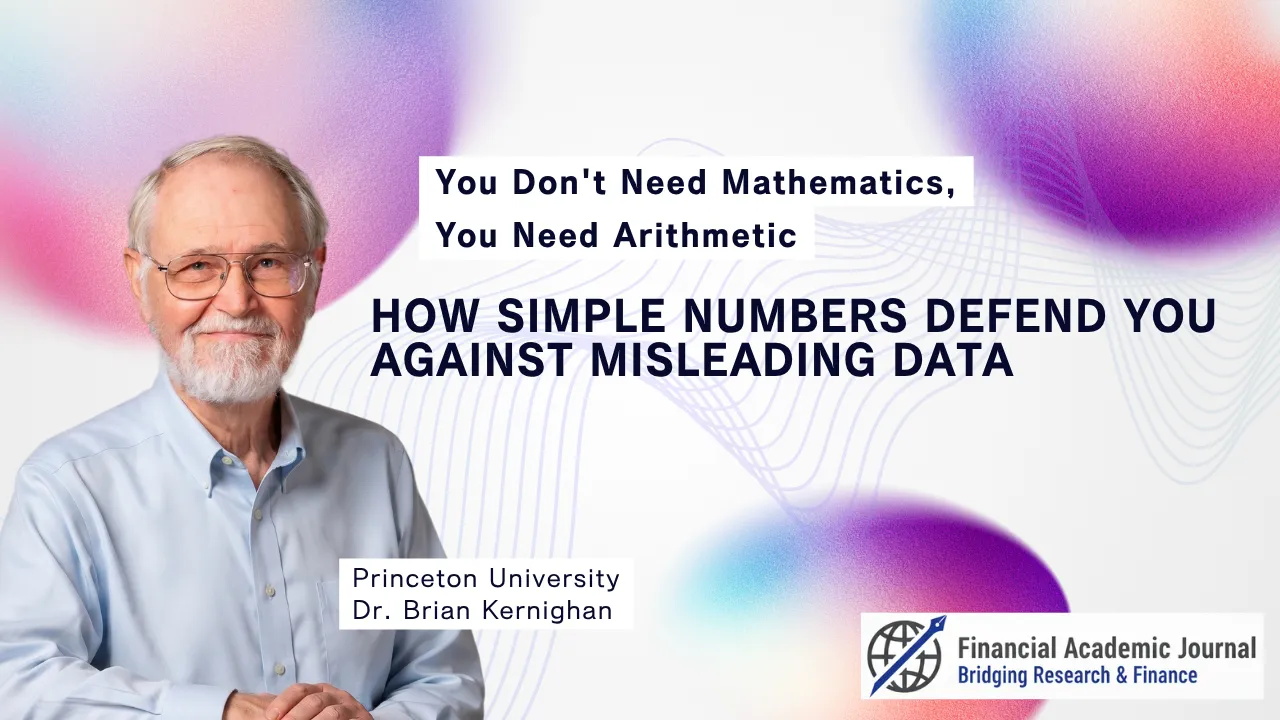
We asked Dr. Brian Kernighan, a professor of computer science at Princeton University and the author of “Millions, Billions, Zillions: Defending Yourself in a World of Too Many Numbers,” how anyone can get on comfortable terms with arithmetic again.
The themes discussed in this interview draw on the following book:
“Millions, Billions, Zillions: Defending Yourself in a World of Too Many Numbers“
The Japanese edition is available here.

Interviewee
Brian Kernighan
Professor of Computer Science, Princeton University
Earned his doctorate in electrical engineering at Princeton in 1969. Following a long tenure at Bell Labs, he returned to Princeton in 2000 to join the Computer Science department. He had a hand in creating several programming languages, AWK and AMPL among them, as well as a range of tools built for preparing documents.
He has co-authored roughly a dozen books alongside a body of technical papers, holds five patents, and belongs to both the National Academy of Engineering and the American Academy of Arts and Sciences. Programming languages and software tools form the core of his research.
He has also produced a number of titles on technology written for readers without a technical background: “Understanding the Digital World” (2017), “Millions, Billions, Zillions: Defending Yourself in a World of Too Many Numbers” (2018), and “Unix: A History and a Memoir” (2019). The second edition of “The AWK Programming Language” appeared most recently, in 2023.
Arithmetic Is Not Mathematics — and the Distinction Changes Everything
Financial Academic Journal (hereafter, FAJ):
To open with, we would like to know what habits of mind people who handle arithmetic well tend to have built up.
Mr. Brian Kernighan:
Allow me to separate two words before I get to that. Mathematics is the elaborate, advanced end of things, and the chances of an ordinary person reaching for it on a regular basis are slim. Plain arithmetic is another matter entirely — you draw on it nearly every day of your life, and at roughly the level an American elementary school covers.
As for habits, a fair question is whether any of what you sat through in a classroom decades ago genuinely surfaces in adult life. My argument throughout has been that it does: arithmetic earns its keep long after school ends.
Something else worth stating plainly is how modest the arithmetic in question really is. Multiplying or dividing rounded figures, or running a very coarse calculation, will usually carry you all the way. No calculator is required, no app on your phone either. A pencil and a scrap of paper can help, though there are occasions when even those are unnecessary.
Every Number You Are Handed Arrives With a Motive Attached
FAJ:
Is there a particular attitude one should bring to the figures encountered day to day?
Mr. Brian Kernighan:
Consider where the figures crossing your path actually originate. Somebody wants to sell you a product, secure your vote for a candidate, or talk you into backing their position. Meeting those numbers with a degree of doubt is the appropriate response, and caution costs you nothing. When a figure lands in front of you, pause long enough to ask why it is being described as interesting, important or relevant, and what the odds are that it holds up. Paying attention to the circumstances behind a number matters enormously.
The point is to keep the whole business plain and unfussy while directing it at the things that actually matter to you. Asking “why?” as you look at a figure, or as you work a calculation through — that habit of mind outranks everything else, both in your private affairs and in your role as a citizen.
Walking to Osaka: Estimation as a Training Exercise
FAJ:
Thank you. For someone who considers themselves poor at arithmetic, what sort of practice would you recommend?
Mr. Brian Kernighan:
This is no different from anything else on earth. Repetition improves you. Certain things simply demand a longer run at them — Japanese never came to me, though more practice would surely have moved the needle. Arithmetic behaves the same way. Every additional time you work through something yourself and reflect on it, the odds improve that it will feel lighter as the months pass. My concrete suggestion is to produce estimates on your own, drawn from whatever sits within reach of your everyday life.
Here is one picked at random. Say I want to get from Tokyo to Osaka. The shinkansen manages it in roughly three hours. Now, how many hours on foot? The distance runs a little past 500 kilometers, and a walking pace lands somewhere around 5 or 6 kilometers per hour. That puts you at about 100 hours of walking. The example may strike you as pointless, yet reaching for tidy figures such as 500 and 5 is precisely the right instinct — 500 divided by 5 needs neither a formula nor a machine.
Putting numbers to a scenario is what lets you make sense of it, and it lets your common sense weigh in on whether the result deserves to be believed. Does 100 hours on foot between the two cities sound plausible to somebody who lives in Tokyo and has a feel for the country? Notice, too, that my version assumes you never halt, never sleep and never eat, walking straight through for five days. Greater accuracy would require adjusting for all of that. And whether you trace the rail line, the highway or a coastal route will obviously shift the answer as well.
Repeated practice of this kind is what lifts your arithmetic. As I said, rough work with rounded figures gets you where you need to go. One thing I have found effective is handing my students an estimation problem and telling them to resist reaching for Google, since the entire value lies in running your own mind at it and producing something. Reason it out without the internet or a calculator, arrive at a figure, then compare notes with others to see whether you landed nearby or wide of the mark. That feedback sharpens you, and confidence in your own arithmetic follows.
The Rule of 72, Per-Person Shares, and Working Backwards
FAJ:
It becomes clear that daily life offers no shortage of openings for arithmetic, and that most of us walk straight past them.
Mr. Brian Kernighan:
A handful of shortcuts are worth picking up, because they genuinely make life easier. The Rule of 72 is one — it tells you how long a quantity takes to double. Imagine inflation in Japan running at 3 percent. How many years until your money buys half of what it buys now, or until an item carries twice today’s price tag? Take 72, divide by the percentage, and there is your answer. Here that means 72 divided by 3, so prices roughly double over about 24 years.
Headlines I have seen recently supply another case: Japan’s population is shrinking by something in the order of 1 percent annually. How long before 120 million becomes 60 million? Dividing 72 by 1 leaves 72, so the answer sits around 70 years — seven decades from now, half of today’s figure. Plenty of forces act on population, so nobody should treat that as settled. Even so, the calculation is trivial and it hands you a workable picture of where things are headed.
A second trick reveals what portion belongs to you. Take Japan’s national debt, or its budget, and divide by 100 million. That is your share. Running the logic in reverse also helps you catch mistakes. Suppose I had concluded that Osaka was 10 hours away on foot — that implies a walking speed of 50 kilometers an hour, and the moment you see it stated that way you know the earlier figure collapsed somewhere, because nobody walks at 50 kilometers an hour.
All of this proves useful, and once it becomes habitual it turns enjoyable as well. Do even a little of it and you improve, and your own judgments start to feel steadier. You also become the person who notices when something is off — which may well work to your advantage.
Average or Median? The Question That Requires No Calculation
FAJ:
Thank you. Statistics and charts come up constantly in business settings. What should one keep in mind while reading them?
Mr. Brian Kernighan:
This circles back to the very first thing I raised. Approach statistics and charts alert, wary and unwilling to take them at face value.
To be more specific, the gap between an average and a median deserves particular attention. Let me put it as a question. Which individual would everyone in Japan immediately name as spectacularly rich? Musk, Bezos, Gates, someone else — who comes to mind?
FAJ:
Probably Gates, in my case.
Mr. Brian Kernighan:
Gates it is. Four of us are sitting in this Zoom call. Invent a figure for our average net worth — perhaps ¥1,000,000, perhaps ¥10,000,000. That number describes the four people here. Now let Bill Gates join the call, and the average detonates, because his net worth runs somewhere near 100 billion US dollars. The median, by contrast, would barely stir, since it reports whatever sits in the middle of the group.
What you should carry away is this: the phrase “the average is…” ought to put you on guard. Once a Bill Gates enters the data, the whole thing gets dragged so far to one side that the resulting figure describes nobody. Some situations are served perfectly well by an average; in others the median captures what actually matters about a set of numbers. And notice that none of what I have just described involves mathematics. You need only ask yourself whether you are being handed a median or an average.
Too Many Decimal Places Is a Symptom, Not a Sign of Rigor
FAJ:
Are there other patterns that should raise suspicion?
Mr. Brian Kernighan:
Needless precision is one I run into constantly. Japan’s population today stands at roughly 125 million. So if somebody informs you that the figure is 125,345,678, would you accept it as accurate?
FAJ:
Nobody could pin the population down to that degree at any single instant, since it never stops changing.
Mr. Brian Kernighan:
Precisely. It fails because that level of accuracy is unobtainable. Feed anything into a calculator and it will happily return ten significant figures, most of them meaningless static. An excess of digits generally signals that something upstream went astray. Put plainly, when the population of Japan is quoted as 125,345,678, the odds favor an invented number dressed up in precision it never earned.
Sometimes the person presenting such figures simply does not know better. On other occasions the extra digits are deliberate, because an exact-sounding number carries an air of authority it has not remotely earned. Either way, precision beyond what the situation can support should make you suspicious.
My book contains an illustration of this. The United States remains one of only two countries still working in the old English units, so conversions between those and metric get run through calculators and apps, and out come figures of absurd exactitude. Mount Fuji rises to somewhere around 3,700 meters. Push that through a calculator and you are handed 12,139 feet 1.29156…, which serves nobody.
Units, Billions and Dimensions: Where the Costly Errors Hide
FAJ:
As you have pointed out, most everyday situations call for approximate figures rather than exact ones.
Mr. Brian Kernighan:
There is one more failure point to keep watch over, and that is the wrong unit.
Days get used where weeks belonged, or the reverse; months appear where the figure was annual, or the other way around. Establish what the units are, whether they fit, and whether a single source stays consistent with itself throughout. Slip from years into months and you have introduced an error of a factor of twelve.
Enormous numbers — millions, billions, trillions — produce the same trouble, and I see it in the United States and doubtless elsewhere. What “billion” denotes shifts depending on where in the world you are standing. Rendered into Japanese it means 10 to the ninth power; somewhere else the same word points to 10 to the 12th power. Getting that backwards produces a mistranslation of spectacular proportions. Hardly a week passes without my spotting an instance, and not only in disreputable publications. Multiply somebody’s salary by a thousand and they will notice — their life changes. Divide it by a thousand and their life changes too. A factor of a thousand is not a rounding error.
Confusion between a linear measurement and an area is worth watching for as well — the length of one side of a plot of land, say, versus the ground it covers. Draw a circle over central Tokyo with a radius of one kilometer and it captures some number of residents. Stretch the radius to two and the enclosed area quadruples, so roughly four times as many people fall inside. Mixing up the linear dimension with the area dimension leads you to expect twice the people instead. The same confusion shows up with volumes now and then, where quantities climb as the cube rather than as a square or a straight line.
How Charts Mislead: Axes, Baselines and Fancy Software
FAJ:
Understood. Knowledge of this kind clearly underpins any improvement in handling numbers.
Mr. Brian Kernighan:
Bear in mind that the repertoire of tricks available through a misleading chart is extensive.
Darrell Huff wrote a marvelous volume in the 1950s titled “How to Lie with Statistics.” Take a chart meant to display movement over time: lop off everything beneath the smallest value so the baseline sits just under the lowest point rather than at zero, and a trivial drift suddenly reads as an upheaval.
Or take a linear quantity like height. Stand people in a row, record how tall each one is, and it is plain enough who towers and who does not. Draw those same people as figures whose height scales with their volume, however, and the gap between them balloons well past reality. Rendering something inherently one-dimensional in two or three dimensions plants a false impression in the eye.
The axes themselves warrant a close look too. Check what has been assigned to the horizontal and the vertical, whether those assignments are legitimate, whether the spacing holds even, whether stretches have been quietly dropped. Political campaigns lean on this heavily, compressing or stretching intervals of time until the data appears to move in a direction it never took.
One of the less happy consequences of modern technology is that our tools for producing handsome, sophisticated graphics keep getting stronger. The charts that result are therefore capable of ever greater deception. It is, regrettably, fertile ground for anyone who wants to mislead.
A Message to Readers: Nobody Is Too Late to Start
FAJ:
Thank you, this has been a great deal to absorb. As a closing question, would you offer a message to readers who find arithmetic daunting?
Mr. Brian Kernighan:
My answer returns to where we began. Build the habit of actually looking at things, and you will find the arithmetic involved is undemanding.
A stray number catches your eye during a walk, or one surfaces mid-conversation — have a go at it. Multiply, divide, using rounded values. Should it feel awkward, round the figure off or swap an unwieldy one for a power of ten. What counts is that you raise a question and reach an answer under your own power. Ask things like how long the drive to your destination would take, or what the bus would do to that estimate, and produce a figure. In nearly every instance an approximate answer is more than sufficient. Keep at it and you will improve.
Carrying a few basic facts in your head helps enormously as well. Know Japan’s population and estimation becomes possible. Somebody quotes the national budget at some vast number of yen, and you can divide it straight through by the population to find what portion falls to you. Populations, distances, areas, a rough sense of money — that stock of facts is the foundation your estimates rest on, and having it makes you better at building them.
Settle on a number or two, ideally something clean like 1, 2, 5 or 10. Multiply or divide by rounded values. Once the habit takes hold I believe it sustains itself, because working something out turns out to be enjoyable. There is a genuine pleasure in being able to do it. And that pleasure is what pushes you to learn more and to keep finding occasions to practice.
Editor’s Note
Nothing Dr. Kernighan described over the course of our conversation required a formula. Dividing 500 by 5, dividing 72 by 3, dividing a national budget by a population — the calculations stop at the elementary school level. What he is really advocating is not computational skill but a reflex: pausing on a figure long enough to ask who produced it and why.
A population quoted down to the last digit, an average concealing a Bill Gates, a chart whose baseline never touches zero. Each one gives itself away to a reader willing to look twice, and none of them demands mathematics. The defense against a world of too many numbers turns out to be a habit anyone can start building tomorrow.
Interview and text: Financial Academic Journal









コメント