
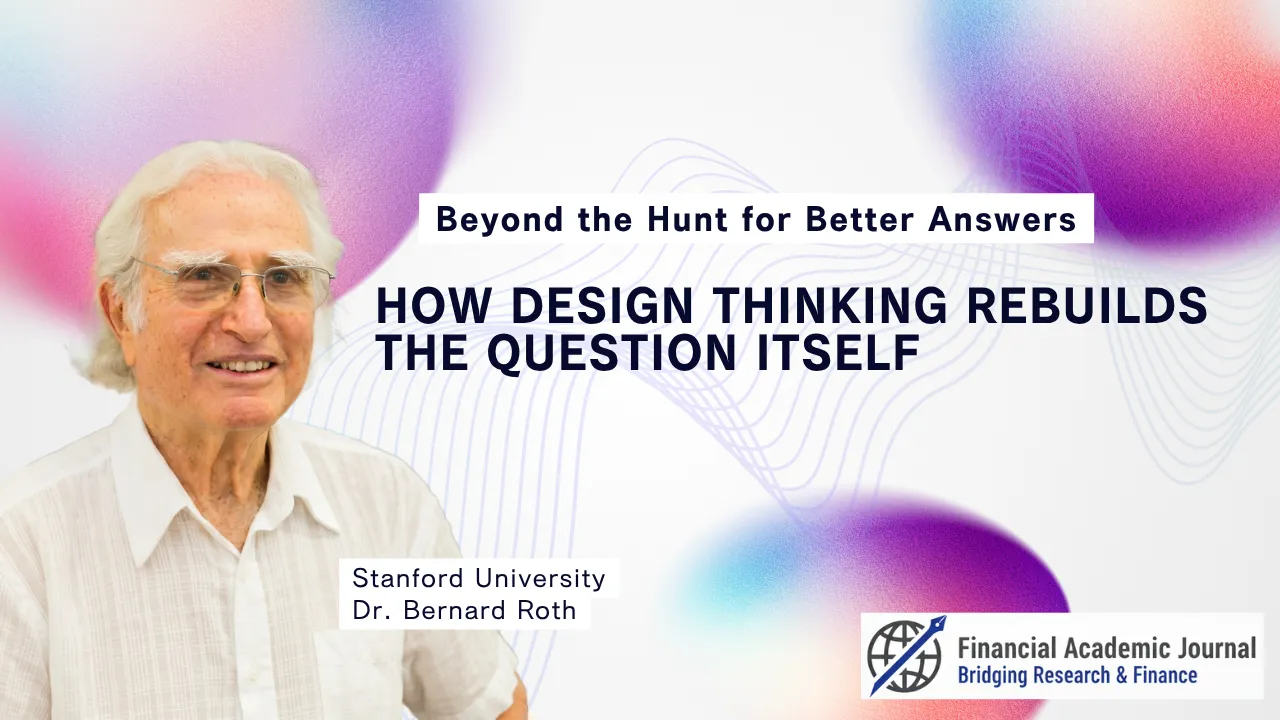
“Design thinking” has become a familiar phrase in boardrooms over the past decade, and the number of people curious about what it actually involves keeps growing.
What tends to go unnoticed, however, is that these techniques do not stop at improving how an organization is run. Absorbed at the individual level, they can reshape how a person builds a career and steers their own daily life.
To explore that territory, we spoke with Dr. Bernard Roth of Stanford University, author of “The Achievement Habit: Stop Wishing, Start Doing, and Take Command of Your Life.”

Interviewee
Bernard Roth
The Rodney H. Adams Professor of Engineering, Stanford University
Completed his doctorate in Mechanical Engineering at Columbia University, and currently holds the Rodney H. Adams Professorship in Engineering at Stanford University. Both the University of Paris and the University of Cassino have conferred honorary doctorates on him. Alongside his academic post he has served on the boards of several corporations and has long run workshops devoted to creativity and personal effectiveness.
More than 200 research papers bear his name, and his work in the classroom as well as the laboratory has drawn numerous honors. He is a founding member of the Hasso Plattner Institute of Design at Stanford — the school known worldwide simply as the “d.school” — where he continues to serve as Academic Director. His most recent book, The Achievement Habit, has appeared in Japanese along with 14 other languages.
What Design Thinking Actually Is: A Designer’s Toolkit Aimed at Any Problem
Financial Academic Journal (hereafter, FAJ):
To begin with, we would like to hear how you would describe design thinking.
Mr. Bernard Roth:
Designers have relied for generations on a particular way of working. Taking that way of working and pointing it at challenges of any description — that is what we mean by design thinking. Pinning down a tight definition is difficult, but one thing is clear: the mental habits designers built up over the years look nothing like those of a scientist or a business professional. What we did was extract a number of those distinctive habits and build them into a process for designing solutions.
FAJ:
What kinds of problems can this approach actually resolve?
Mr. Bernard Roth:
In principle, there is no category of problem it cannot be aimed at. That said, no one can promise permanent world peace, and by the same token no method resolves every difficulty that exists. Certain questions have no visible answer at all, and others may require decades before anything resembling a solution appears. But for the sorts of problems that people in industry and academia wrestle with day to day, this approach tends to serve them well.
Early on, the word “designer” called to mind someone who produced physical objects. Today the same methods are being turned on the underlying architecture of organizations themselves. Systems that support people in difficulty, or the ways human beings deal with one another, fall squarely within its reach — none of which involves manufacturing an object. Bring the approach to bear on a tangled challenge, and better answers tend to surface across an enormous range of situations.
“No Fear of Failure”: Why Building Beats Planning
FAJ:
Is there a particular element that separates this from conventional problem-solving?
Mr. Bernard Roth:
Prototyping is the clearest example. An idea sitting inside the process gets converted into something you can hold, and that object becomes the vehicle for testing your hypothesis. Failure simply is not treated as a threat here. We call the underlying attitude “No Fear of Failure,” and it puts the emphasis on moving first rather than protecting yourself against a poor outcome.
Neither business nor education has fully absorbed that mindset yet. Even so, the last 15 to 20 years have seen it spread rapidly, and the range of settings where it now gets applied keeps widening.
Reframing: More Time on the Question Than on the Answer
FAJ:
Could you walk us through the process itself in more concrete terms?
Mr. Bernard Roth:
No single correct route exists; practitioners take a variety of paths. What sits at the center of all of them is a focus on the human being. A great many established problem-solving methods, even ones built for people, never actually placed people at the center. Mechanical or financial framings dominated instead. Here, the first thing to establish is who the solution exists for. Only after that do you ask what they need, and why this particular question deserves to be raised at all.
Picture a situation where you are my supervisor. You assign me a set of tasks and ask for them on your desk tomorrow — that scenario makes the contrast easy to see.
Under the older way of operating, I would finish exactly what you handed me and return it. Working the other way, I would dig up additional information around those tasks, speak with more people, and — should it turn out the problem may have been framed poorly — say so directly to you. Telling you “the thing worth solving here isn’t B but A, and cracking A gets us a stronger result” is how I help you reach a better answer, and it lets you tackle problems far more effectively.
FAJ:
So it comes down to looking at the situation again from a fresh angle.
Mr. Bernard Roth:
That move has a name: “Reframing*.” Far more of our time goes into rebuilding the question than into chasing the answer. The reason is simple — a badly stated question can be answered perfectly and still leave you nowhere near the outcome you wanted.
Work through that sequence and ideas begin arriving on their own. Brainstorming to widen the field is part of the picture, though nothing obliges you to commit to a single concept. Those concepts then feed a series of prototypes, which get put in front of real people to observe how they behave, and answers take shape as the feedback accumulates. Occasionally the problem itself shifts partway through, so verifying at the outset that the stated problem holds up matters enormously. Ideas of differing weight all deserve testing, and what you ultimately need to establish is whether the solution works as a whole.
The tools involved vary widely. Sticky notes cover the walls in some rooms; elsewhere the preference runs toward direct conversation or survey work. With so many options available, the sensible move is picking whichever fits you.
*Reframing: Taking apart the frame through which something is being viewed, then examining it from another standpoint.
Inside Companies, Designers Have Moved from the Bottom to the Top
FAJ:
Thank you. Does this approach deliver value in a business context as well?
Mr. Bernard Roth:
Take our Launchpad course. It runs for ten weeks, and participants are generating revenue before the opening few weeks are out.
Designers used to occupy the bottom rung of the corporate ladder. The president and vice president sat at the summit, followed by the chief engineer, the sales director and the rest of the workforce, with designers placed somewhere underneath all of them. People viewed them as artistic types, or as holders of a narrow technical skill. Recent years have overturned that picture, and designers now reach the most senior leadership roles at some firms. Those firms have performed remarkably well, because handing designers real decision-making power lets them shape how the organization moves and works at a far earlier stage than any conventional process allows. Seen this way, the approach functions as an adaptable strategy that pays off across widely different commercial settings.
BlackBerry and the iPhone: When Engineering Excellence Isn’t Enough
FAJ:
So there are already businesses succeeding on the back of this method.
Mr. Bernard Roth:
The way designers go about their work bears almost no resemblance to what business schools teach. Graduates of those programs generally need several years before anything emerges, and their attention stays fixed on the plan and on steering clear of mistakes. Our side of the fence favors taking on fresh challenges constantly, treating a failure as something useful, and extracting the lesson buried in it. There is a great deal to learn from things going wrong — and the fact that something functions smoothly is no proof that the route taken was correct. So we confirm the problem is the right one, run the experiment, and when it collapses we take what it taught us. The speed of that loop is what allows ideas to advance in all kinds of contexts, and what designers have produced is now in use across countless industries.
Consider the BlackBerry, the handset that once enjoyed enormous popularity. It was a refined piece of hardware with genuinely strong design, yet production has long since stopped. The arrival of the iPhone hit it hard. Technically the BlackBerry was the stronger phone, but it could not reproduce the human interaction — the bond forming between a person and the device in their hand — that the iPhone delivered. One was built out of an engineering mentality; the other was exactly what emerges when design thinking drives the work. A modest shift in thinking, then, can alter a product, a company, or your own working life dramatically. Plenty of situations end in success, though it would be dishonest to pretend the outcome never disappoints.
The MRI Room That Became an Adventure
FAJ:
Is there an example that shows the human-centered perspective at work?
Mr. Bernard Roth:
General Electric’s MRI scanner is a good one. Like the BlackBerry, the machine represented a genuine technological achievement — and children wanted nothing to do with it. What they saw was a metal monster, and their fear ran so deep that sedation became necessary before they would go inside. The device performed exactly as engineered, which left its designers thoroughly puzzled by the rejection. Their response was to widen the conversation: not only engineers, physicians and nurses, but the children, the patients, the people actually going into the machine.
Along the way they met children whose chronic conditions had kept them inside hospitals for most of their lives, and who therefore had none of the sporting trophies their brothers and sisters had collected. Out of that encounter came a conviction that what these children were missing was adventure. The room was repainted as a jungle, a ship, a night sky crowded with stars. Staying perfectly still became the price of spotting the stars, or of staying hidden from pirates. Once the space around the scanner had been turned into what became the Adventure Series, sedatives were no longer required. It is a single case, but it demonstrates how a small alteration produces a large result.
The children staying in that hospital are not clinicians, nor nurses, nor parents. They are children. Identifying precisely who you are designing for is the thing that matters most. And reaching an outcome of that kind is unlikely to happen through business reasoning alone.
A Message to Readers: Start by Checking Whether the Problem Is the Right One
FAJ:
Thank you. Lastly, would you share a message with our readers?
Mr. Bernard Roth:
Should your present approach be delivering results, by all means carry on with it. If instead you are hoping for change or improvement — and like everybody else, you simply want things to be better — then experimenting with unfamiliar methods is the sensible move. Design thinking is one of those methods, and anyone deciding to give it a try should begin by verifying that the problem in front of them is the correct one. In the great majority of cases, people set off against the wrong problem from the start and never arrive at the result they were after.
Asking whether the issue is being approached from a human-centered position matters just as much. That is the reason I would encourage you to bring this way of thinking into your own life. You will not regret having done so.
Editor’s Note
“Is the question you are answering the right question?” — Dr. Roth returned to that point again and again throughout our conversation. Design thinking, in his telling, is less a technique for producing answers faster than a discipline for pausing before the answer and rebuilding the question itself.
A repainted room removed the need to sedate frightened children. A device that lost to a technically weaker rival did so over the relationship between person and object. What both stories share is a starting point located in the human being rather than in the specification. That starting point is available to any reader, in any role, beginning tomorrow morning.
Interview and text: Financial Academic Journal





コメント