
For any entrepreneur or professional with ambitions beyond their home market, picking up a foreign language remains close to unavoidable. Anyone who has attempted it knows the catch: the hours pile up, the sense of progress does not, and a great many people walk away before the payoff ever arrives.
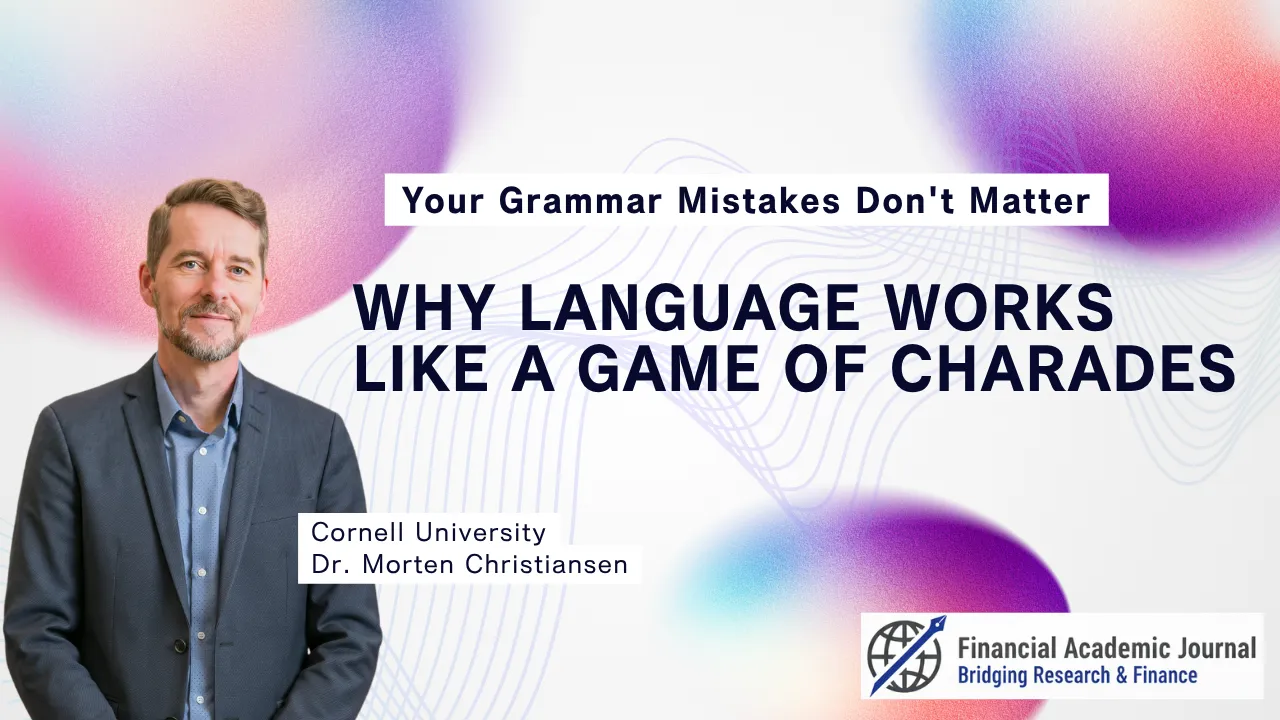
We sat down with Dr. Morten Christiansen, a professor of Psychology at Cornell University and co-author of “The Language Game,” who offered a fundamentally different account of what language is — and what that account implies for anyone struggling to learn one.

Interviewee
Morten H. Christiansen
Professor of Psychology, Cornell University
Dr. Morten H. Christiansen holds the William R. Kenan, Jr. Professorship of Psychology at Cornell University. He is also Professor of Cognitive Science at Aarhus University in Denmark, where he is attached to both the School of Communication and Culture and the Interacting Minds Centre, and serves as a Senior Scientist at Haskins Labs @ Yale.
His memberships include the Royal Danish Academy of Sciences and Letters, and he was elected a foreign member of the Royal Norwegian Society of Sciences and Letters. He is likewise an elected Fellow of both the Association for Psychological Science and the Cognitive Science Society. His output runs to more than 250 scientific papers, along with four edited volumes and two monographs.
Written for a general readership, his latest book — “The Language Game: How Improvisation Created Language and Changed the World” — lays out a radically different account of how language operates, and has appeared in a number of languages, Japanese among them.
X Official Account: @MH_Christiansen
The Fear of Getting It Wrong Is What Holds Learners Back
Financial Academic Journal (hereafter, FAJ):
We understand that English came to you as a second language. Drawing on both that experience and your research, could you offer our readers some guidance on learning a language effectively?
Mr. Morten H. Christiansen:
With pleasure. The difficulty of acquiring a foreign language is not something I take on faith — as you say, I went through it myself. I am Danish, and Danish was the language of my childhood.
Part of what makes the process feel so punishing, I suspect, is that learners keep applying the brakes to themselves out of a fear of error. The anxiety takes familiar forms: that a word will surface in conversation which you have never encountered, that some subtlety of grammar or word formation will trip you up, that you have not properly mastered the honorifics the language demands. My response to all of it is that none of this warrants your worry. Simply speak.
Watch a child and you see errors arriving constantly, greeted with complete indifference, because what the child wants is to be understood. Falling short of perfection is therefore no obstacle. Words may be off, phrases clumsy, grammar wrong — and comprehension still happens, provided both parties work at the conversation together.
Language as a Game of Charades: Improvisation Between Two Minds
FAJ:
When you describe working at a conversation together, do you mean that we are guessing our way toward what the other person intends?
Mr. Morten H. Christiansen:
Precisely. The argument we advance in The Language Game is that using language has a great deal in common with a round of charades. One player receives a subject — a film title, a book — and must convey it to a teammate with nothing but gesture. The teammate’s job is to work out what is being acted out. Say the film is King Kong: you might pound your chest to point toward the enormous ape at the centre of the story.
Language, we contend, runs on the same machinery. Both rest on improvisation and on active cooperation in the present moment, with each party throwing out clues so that a shared sense of the intended meaning can be assembled. The essential claim is that communication through language is collaborative at its foundation.
Listening is not a matter of sitting still and taking delivery of a message the way a machine would. We are drawing on everything at our disposal — what we know of the other person, what has already been said, what we understand about the world — in order to make sense of the words arriving. Understanding gets built jointly, one improvised move after the next, exactly as in charades.
Children Never Really Learn Grammar at All
FAJ:
Where does grammar fit into that picture? Many adult learners treat it as the foundation everything else rests on.
Mr. Morten H. Christiansen:
Think again about children. Grammar occupies no part of their attention while they are communicating. What absorbs them instead is working out what the people around them mean and getting their own meaning across, and they pursue both cooperatively. One could go further and say that children never really acquire grammars in the first place.
All a grammar does is describe abstract regularities in how a language gets used; producing or understanding speech requires no such description. What children actually do is recycle small pieces of language they have heard before, assembling them — occasionally in combinations nobody has used before — into fresh sentences, and from there they gradually learn to generalize across those pieces. Applied to a foreign language, the implication is that flawless grammar is unnecessary: fragments of language plus a capacity to generalize over them will carry you a remarkably long way.
“I Like X”: How Generalization Builds New Sentences from Old Pieces
FAJ:
Could you unpack what generalization refers to within language science?
Mr. Morten H. Christiansen:
The term covers a wide territory in the field, but what I have in mind here is generalization across small pieces of language. Suppose you encounter the sentence “I like milk.” Later you overhear “I like coffee,” then “I like sake,” then “I like wine.” At some point it clicks that a reusable frame is sitting there — “I like X,” with X standing in for whatever you happen to like. Armed with that, you produce something of your own: “I like chocolate.”
Generalization operates along those lines, and we take it to be how children get to grips with language as well. None of this happens inside a year; the timescale is considerable. Children devote vast quantities of time to the task, attending to what those around them say and recycling portions of it as capably as they can manage.
Collect Chunks, Not Vocabulary Lists
FAJ:
Adults do not have a child’s supply of time to devote to this. Is there a technique you would recommend for moving faster?
Mr. Morten H. Christiansen:
What our work points to is the value of taking in combinations of words as single units rather than as separate items. These multi-word chunks are enormously useful to a foreign language learner, since identifying a whole phrase costs far less effort than identifying each word in turn and then puzzling out what the assembled result is supposed to mean. Have expressions such as “I don’t know” or “Can you help me with this?” ready to hand, and you can deploy them mid-conversation, which does a great deal for your fluency.
Their usefulness is not confined to speaking, either. They also make the apparently breakneck pace of incoming foreign speech considerably easier to handle. Building up a stock of the chunks that occur most often is excellent preparation for genuine interaction in your target language — and yet our education systems, as they currently stand, frequently do nothing to support that kind of learning.
Why Classroom Study Collapses on Contact with Native Speakers
FAJ:
What is it about current language education that leaves us unable to cope with speech as it actually unfolds?
Mr. Morten H. Christiansen:
A large share of foreign language instruction is built around reading passages from a textbook or listening while somebody, usually the instructor, delivers model sentences — and students are rarely given enough time to talk with one another. The consequence shows up the moment you find yourself among native speakers on a trip or in front of a film: comprehension turns out to be minimal. Everybody appears to be talking at impossible speed. A few words may register, yet the meaning slips past you. My view is that this stems from how little effort language teaching puts into helping people manage language as it happens.
The research I pursue in my lab, together with my graduate students and colleagues, concerns exactly this question: how might a learner’s capacity to operate in a foreign language in real time be strengthened — ordering a meal, asking directions in the street, and so on. It is here that our findings suggest attention to multi-word chunks could pay real dividends.
What AI Is Missing: Prediction Without Interaction
FAJ:
The field has moved extraordinarily fast lately, machine translation included. It raises the question of whether AI might come to possess linguistic abilities comparable to ours, and we would value your perspective on that.
Mr. Morten H. Christiansen:
A genuinely interesting question, and the honest short answer is that I do not know. As I said earlier, human language is collaborative and interactive right down to its foundations, in the sense that we are jointly reaching toward a shared understanding of the subject at hand. That is not the regime under which AI models are trained, at any rate not the ones we have now. Charades is not a game they play, and we take charades to be central to how language functions. They do not, in short, interact the way we do.
These models are fed enormous volumes of data and trained to predict whichever word comes next. That exhausts the description. And what our own research with such models indicates is that this may fall short of reproducing the full range of human linguistic ability. What we found specifically is that interaction and feedback appear to matter a great deal — for AI systems no less than for people. We have been putting models such as ChatGPT through the same procedures we would use on human participants in the laboratory. The pattern in our results is that models trained with human feedback come much closer to human behaviour in how they handle language use.
Put differently, a successful model needs its language corrected through human responses to what it has produced; exposure to billions of words on its own does not suffice. What this throws into relief is the interactive dimension of language, generally absent from these systems, which we hold to be fundamental to the human version.
If Machines Learned to Improvise, Would They Understand Us Better?
FAJ:
Supposing AI were taught to play charades, what do you imagine would follow?
Mr. Morten H. Christiansen:
Should we succeed in teaching them the game, there is a serious prospect that their linguistic capacities would move beyond our own. Where that leads is anybody’s guess. It could position them as a danger to us, or turn them into instruments for manipulating people with greater ease — something whose early stages are visible already.
The brighter possibility runs the other way. If they did acquire the game, and if we brought them into conversation with us on collaborative, interactive terms, they might well grow more empathetic toward us. A better understanding of what we are as humans might follow — and perhaps then they would not set about disposing of us, in the manner of the gloomier science fiction films.
A Message to Readers: Nobody Is Keeping Score of Your Mistakes
FAJ:
As a closing question, would you offer a message to readers who are finding language learning a struggle?
Mr. Morten H. Christiansen:
What I most want other learners to take away is how vital it is to hurl yourself into actually using the language. Errors are not worth your anxiety. Speak.
Direct your attention toward getting yourself understood, and the person opposite you will reciprocate by concentrating on what you are trying to say rather than cataloguing where you slipped. Native speakers, incidentally, produce errors continuously, and nobody takes much notice of those either.
An ordinary conversation consists of two people cooperating toward a shared grasp of the topic. Mechanisms exist for repairing misunderstandings and carrying the exchange forward. Lost the thread of what someone said? Asking them to clarify is always available. A nod will signal that you are following along. These supplementary conversational instruments belong to all of us, and they function perfectly well when the language in question is not your own.
So on the subject of speaking a foreign language, my message is to go ahead and speak, because your mistakes are of no consequence to anyone else. Throw yourself in and start talking.
Editor’s Note
The advice at the end of this conversation — stop worrying, just speak — is familiar enough to sound like encouragement and nothing more. What makes it different in Dr. Christiansen’s hands is that it descends from a theory. If language really is a game of charades, then the listener was never a passive receiver waiting for a well-formed sentence, and the errors we spend years dreading were never the obstacle we imagined.
The same theory carries an unexpected implication for machines. A system trained on billions of words but never corrected by a human being is, on this account, missing the very thing that makes language work. Whether the answer to better AI turns out to resemble the answer to better language learning — get into the conversation and let it correct you — is a question worth watching.
Interview and text: Financial Academic Journal





コメント