
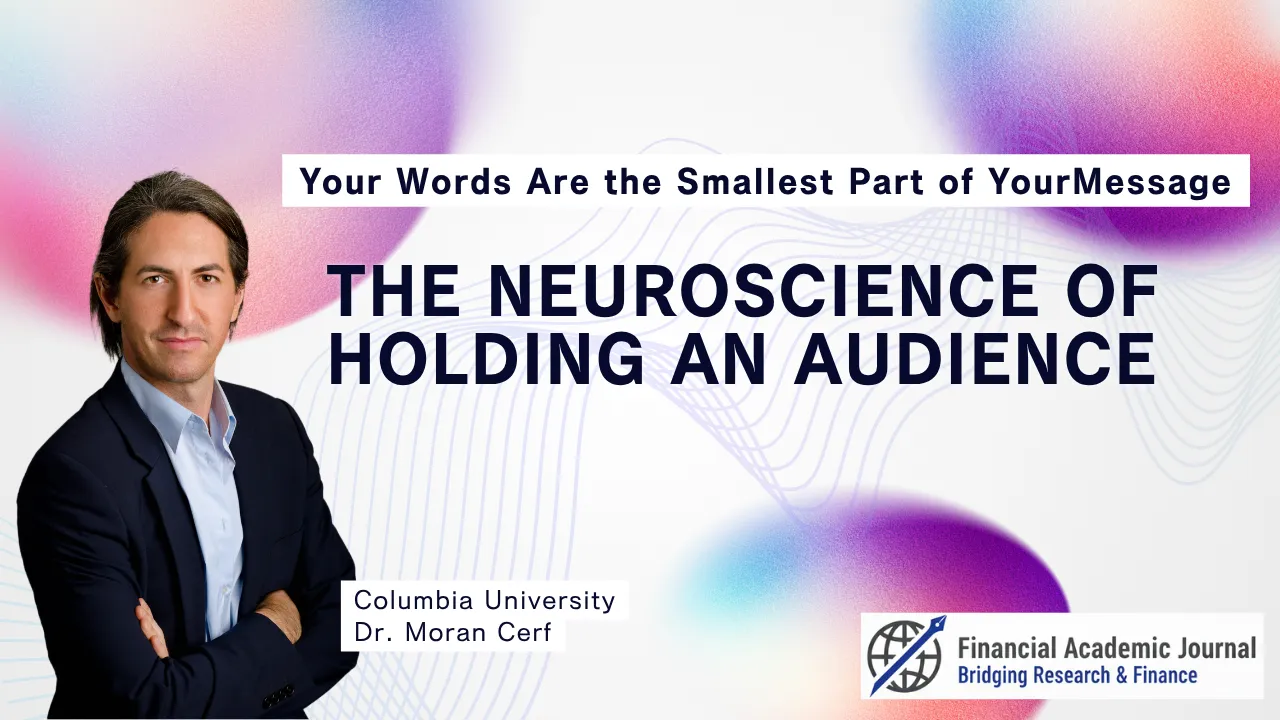
Standing in front of a room — a product launch, a shareholder address, an all-hands — and holding everyone’s attention ranks among the persistent worries of founders and executives alike. The deeper question underneath it is whether the message and the vision actually reach anyone.
Seeking answers, we interviewed Professor Moran Cerf, a neuroscientist whose field is human behaviour. Drawing on his laboratory work and his years on stage, he walks us through the machinery operating beneath every act of communication.

Interviewee
Moran Cerf
Professor of Neuroscience and Business, Columbia University
Dr. Moran Cerf teaches neuroscience and business at Columbia University. His doctorate in neuroscience comes from Caltech, and Tel-Aviv University awarded him an MA in Philosophy alongside a BSc in Physics. His practice involves helping both individuals and organizations put current findings about the brain to work — sharpening how they think, lead, develop themselves, arrive at decisions and connect with customers.
He has supervised upwards of 50 students, holds a number of patents, and has produced 5 books along with more than 70 academic papers appearing in journals such as Nature and Science, as well as in popular science outlets including Scientific American Mind, Wired and New Scientist. Much of his work has reached general audiences through talks at PopTech, TED, TEDx — where he holds the record for the most TEDx talks delivered worldwide — and the World Economic Forum, accumulating millions of views and a substantial following.
Why Identical Words Land Differently Depending on Who Speaks Them
Financial Academic Journal (hereafter, FAJ):
Having watched a considerable number of speeches and presentations over my career, I have noticed that comparable material can leave audiences with strikingly different impressions depending on the person at the front. What accounts for that from a neurological standpoint?
Mr. Moran Cerf:
Words form only a fraction of what communication actually is. Vocal cues, the tempo you speak at, the way your body moves, the rise and fall of your voice — these signals and a great many others combine to produce the effect. Consider borrowing a famous address, Martin Luther King’s “I Have a Dream” for instance. Deliver those exact words yourself and the impact will not replicate, because none of the history and background attached to King at that podium is attached to you. The context surrounding him when he spoke is not your context, so the audience cannot undergo the same experience. Two speakers uttering identical sentences can produce nearly opposite results, since people are constantly reading what sits between the words.
What Interviewing Con Artists Alongside an FBI Agent Revealed
FAJ:
Is there a case from your own research that illustrates how much sits outside the words themselves?
Mr. Moran Cerf:
Some years back I received a request to interview people who had committed crimes — specifically, individuals whose life’s craft consisted of deceiving others into handing over money. My brief as a neuroscientist was to work out the mechanics of what they did, and I carried it out alongside a former FBI agent whose expertise lay in reading bodies. I examined the substance of their statements and the workings of their minds while my colleague tracked what their conduct gave away: their movements, their handling of language, everything transmitted without speech.
What surfaced was that these operators had mastered delivery every bit as thoroughly as content. They understood how to make a thing resonate, when precisely to hold your gaze, at which instant a smile would do its work. One man in particular stays with me. What he actually said carried little persuasive weight, yet he simply looked like someone trustworthy and guileless. Purely visually. He registered as soft-spoken and considerate. Anything leaving his mouth sounded credible notwithstanding that most of it was fabrication, and people were glad to hand him considerable sums. He wound up imprisoned as one of the largest confidence tricksters in Europe.
My takeaway was that an enormous number of components ride along with a message beyond the literal words, and every one of them warrants consideration when you set out to deliver something. In one exercise I run while teaching this material, we screen recordings of presentations and speeches with the sound switched off. Only the visual reaches you, and we measure how persuasive someone appears with the content stripped away.
Within limits, we can forecast what will bring out the strongest version of you, and equally identify what will not serve you. Possessing that knowledge undeniably improves your odds of doing well.
The Governing Principle: Align Your Brain With Theirs
FAJ:
How does one capture an audience’s interest during a presentation?
Mr. Moran Cerf:
A handful of approaches demonstrably function and a handful demonstrably do not. Framed neuroscientifically, engagement requires that you bring your brain into alignment with the brains in front of you. The better your grasp of how those people think, the greater your chances of landing something that holds them. This principle sits above everything else on the list. Which leaves the operative question: what is it that actually generates engagement?
Humour Buys You Thirty Seconds of Undivided Attention
Mr. Moran Cerf:
Several things reliably work. Humour, to begin with, is a formidable instrument. It dissolves the initial awkwardness and functions as a lubricant for whatever follows, which makes it especially valuable early on. Land something amusing and tension disperses at once, leaving people inclined to attend more closely to everything that comes next.
We have quantified how much engagement accrues in the wake of laughter, and the figure comes to roughly 30 seconds of undivided attention purchased by a single moment of amusement. Engineer those peaks of amusement at the right junctures and you can count on firmer focus across the passages that follow.
It also reclaims the people who had already drifted off — pulling the departed back into the room, at least briefly. Picture someone paying you no attention whatsoever, scrolling through their phone while you speak, who suddenly registers laughter erupting all around them at something you said. The thought that follows is: what did I miss, and is this something I ought to be tracking more carefully? They tune back in for the next stretch. As a device for recruiting attention, humour is exceptionally strong.
Perceived Vulnerability, and Why Opening With a Brag Is Hard to Undo
Mr. Moran Cerf:
Another item in the arsenal is what we call perceived vulnerability. Speakers who read as modest, open and dependable generally receive more goodwill and more warmth from a room. Suppose you have an hour ahead of you: if the opening minutes establish that you are not merely an expert but also someone who declines to boast, with credibility that is both high and pertinent, the likelihood rises that people will listen attentively, drop their guard, and set aside their reflexive scepticism.
None of this is counterintuitive, and yet we have watched speaker after speaker neglect it — or invert it entirely, opening with boasting, or worse, with name-dropping and humblebragging, under the impression that this is what impresses a room. Damage of that variety is typically very difficult to reverse.
The Three P’s: Pauses, Posture, Position — and Props
Mr. Moran Cerf:
A further set of instruments concerns deploying your voice and body to give your points shape and prominence. Call them the three P’s: pauses, posture and position.
Insert a pause and whatever arrives afterwards acquires prominence, drawing sharper attention. The technique costs nothing to apply. Posture likewise exerts substantial influence over how content registers with people. Actors know this intimately and devote considerable rehearsal time to the precise stance that will optimize a delivery. A piece of advice actors frequently pass along is to generate movement above the waist — gestures, torso — rather than below it, meaning legs, or pacing back and forth.
Where you position yourself should be a decision rather than somewhere you merely wound up without thinking about it. Choosing to stand behind a podium ought to have a reason attached, such as signalling greater formality. Taking a chair should be equally purposeful, perhaps to appear more relaxed or more intimate. Props deserve the same treatment — a microphone, a set of notes. Nothing should be in your hand simply because it happened to be available; it belongs there because it accomplishes something. My colleague Neil deGrasse Tyson holds a handheld microphone because it lets him demonstrate ideas: the microphone becomes a spacecraft, or a star he is orbiting. That is a deliberate choice, not an object he happens to be holding.
Rhetorical devices deserve attention as well. Posing questions — rhetorical ones especially — sets the audience thinking, and frequently they will answer internally before your own answer arrives, so it pays to consider where in your material that effect would serve the flow.
Break It Into Nuggets, Then Say It Again
Mr. Moran Cerf:
Then there are all the decisions attaching to the content itself. Dividing a lengthy message into brief components frequently helps in rendering complicated material digestible. It also lets the audience anticipate how to distribute their own mental resources. Speaking for an hour, tell people at the outset that the hour will arrive in four parts. Attention invariably fluctuates, and the ability to plan mentally how one’s concentration will be rationed helps people stay with the content.
This is also part of why inviting questions sometimes helps: it fractures a long stretch into smaller mental parcels and grants people a moment to absorb what has already reached them. Anyone who has endured a wedding speech knows that complaints about brevity never materialise, whereas complaints about length arrive in quantity. Practise compressing the same message and you will grow better at holding people, because they learn your rhythm and come to expect material in portions they can process.
Repetition is another asset. State something at the beginning and return to it repeatedly, and you have signalled to the room that it matters while making it substantially easier to retain. People tend to feel awkward about repeating themselves, though as a messaging instrument it is genuinely valuable.
Above Everything Else: Know Who Is In the Room
Mr. Moran Cerf:
And the one that outranks all the others is knowing your audience — which I raised earlier, so consider this a live demonstration of how repetition operates.
Specialists in a narrow field call for a different register than newcomers do. Addressing a child, you might want to retire the historical analogies predating their birth. Facing people hostile toward you, hold the friction-generating topics until late and open on the ground everyone shares. Speaking with someone invested in your success, lean into what already aligns between you. I cannot construct a scenario in which additional knowledge of the audience failed to prove useful. It is the qualitative expression of what I said before: the goal is bringing your brainwaves into alignment with whoever is receiving the message, so any instrument that advances that goal is indispensable.
Managing a Team: Hand People Agency
FAJ:
How should communication be used in developing the people on your team?
Mr. Moran Cerf:
Here I will apply what I just recommended in my previous answer and keep this short and plain. Leave them feeling empowered and in possession of agency.
One useful tactic is letting them do more of the talking in meetings. Walk in and say that you want to hear their views, or that you have questions for them, and their sense of agency increases because their opinions get an airing. Whatever you need to convey can travel through the questions you pose. Wanting to offer advice, ask first whether you may — and they will prove far more receptive to what follows, and better disposed toward you, than if you had simply imposed it. Replace “let me tell you what to do” with “may I tell you what I think you should do,” and your message registers as a supportive proposal rather than an instruction.
Broadly, the research of Robert Cialdini, who studies persuasion, underpins many of the practical suggestions I am making here. On his account, reciprocity and trust are the principal engines of persuasive communication. Should I demonstrate the behaviours I would like you to display, my odds of convincing you that they are worthwhile — and genuinely worth adopting — improve dramatically. With my own team, I make certain I embody a thing myself before I say a word about it.
Surprise, Perspective Thinking and Cross-Brain Correlations
FAJ:
Is there recent research on engagement and communicating with subordinates that you consider overlooked and worth raising?
Mr. Moran Cerf:
One line of recent work examines building engagement through unexpected experiences. Connecting to your earlier question: if a manager enters a meeting and announces that although the usual arrangement has them issuing instructions, today the roles will invert and they want to hear what their team would like to do — that manager has not only conferred agency but delivered a surprise by stepping outside the customary organizational script. Both empowerment and a departure from stereotyped dynamics, in a single move. The surprise itself, according to this research, is likely to shift how you think and pull a different answer out of you.
More broadly, a considerable amount of interesting work is emerging on perspective thinking — a variety of empathy concerned less with feeling what another person feels than with reasoning from inside their worldview. Occupying someone else’s position turns out to be a fast and highly efficient route to aligning brain activity, and the findings indicate it serves several communicative purposes at once. Notably, your ability to anticipate what someone will do next improves markedly.
Say something along the lines of “were I in your position I would do this — what’s your view?” and even where your suggestion diverges from what they want, people receive it as supportive. Comparable formulations include telling someone you recognise this is probably hard for them, and that you would like to hear how they want to approach discussing it. Every one of these signals that you are not broadcasting an order at a subordinate but offering a perspective and attempting to understand them, all while making your own preference perfectly clear. Studies employing Cross-Brain Correlations — the method we devised for quantifying alignment across brain activity — show this to be remarkably effective at synchronising brainwaves. It does an excellent job of bringing people toward you in their willingness to take input.
Active Listening: “Here’s What I Heard — Did I Get It Right?”
FAJ:
Where does listening sit within all of this?
Mr. Moran Cerf:
Contemporary findings in organizational behaviour concerning work with subordinates place listening above every other consideration, and the research concentrates on a technique known as active listening. The method has you let the other person speak without interruption while you work at suppressing the urge to interject. Taking notes as they go is worth considering, to be sure nothing escapes you. Once they have finished, you say: here is what I believe I heard — have I understood you correctly? The process is complete only when they confirm it. The active component frequently also involves clarifying questions, ensuring the speaker has produced everything before your response begins.
It costs somewhat more time. What it buys is an enormous difference in how people experience the dynamic of a conversation. The objective throughout is leaving people feeling heard. That sensation of being heard and empowered raises the likelihood that they will execute well on what you were hoping for. They move faster, operate more efficiently, and want more to help you.
A Message to Readers: Build Your Own Battery of Role Models
FAJ:
What advice would you give younger entrepreneurs and students on putting your research into practice?
Mr. Moran Cerf:
I do, and it is simple. Begin noticing how you communicate and pin down what functions for you. That process assembles a collection of methods suited specifically to you. You may well discover that only some of what I described applies to you while the remainder does not. Excellent. Provided you keep testing, you will be fine.
Here is my own practice. I regularly go to YouTube and work through assorted videos of public speakers — commencement addresses, political speeches, stand-up comedy. Some of those speakers strike me as excellent at conveying ideas and others strike me as dreadful. I then stop and interrogate myself about what appealed to me in the former and what repelled me in the latter. Communicators I admire get saved, and now and then, with a talk of my own approaching, I watch one to refresh my memory of what I liked. It never fails to help.
Reviewing the videos I saved, patterns and qualities emerge that match my own style — the thing people describe as finding your voice. I also begin cataloguing which properties I am capable of reproducing. Timing, for one, is something I came to weigh far more heavily after spending a stretch watching comedians. Smiling at the correct instant. Seeking confirmation from an audience at the point where they need bringing in.
The genuinely critical part, though, is to collect. Arrive at a moment unprepared and attempt to conjure the things that work, and I will almost certainly miss the small details that constitute good communication. Actively hunting for role models leaves you with a battery of options to draw from.
And this matters: tastes are not universal. Everybody’s battery differs. You may favour speakers who close on a joke where I favour those closing with a call to action. You may prefer the meticulously prepared where I prefer the apparently improvised. Gather enough footage and the patterns aligning with your own brain become easy to spot. Assembling that battery is the best advice I have to offer.
Editor’s Note
The most unsettling moment in this conversation was the con artist who looked trustworthy. Everything Dr. Cerf catalogues afterwards — the pause, the posture, the deliberate prop, the thirty seconds purchased by a laugh — is the same machinery that man had mastered. Which raises the question of what separates persuasion from manipulation, and the answer appears to be nothing at the level of technique. Only what you are using it to say.
What stayed with us instead was his closing instruction, which is not a technique at all. Watch people. Notice what moves you. Save it. The battery he describes cannot be handed over ready-made, because the patterns that align with one brain will not align with another — which is, in the end, the same principle he opened with, pointed back at the speaker rather than the room.
Interview and text: Financial Academic Journal






コメント